

Key Takeaways
Choosing activities that actually develop skills
After-school enrichment ranges from genuinely skill-building to loosely educational at best. The difference often comes down to whether the activity requires a child to practice a specific cognitive or social process repeatedly, not just attend and observe. Parents sorting through options for their children benefit from asking what a given program actually exercises, and whether that aligns with where their child has room to grow.
Cost is a real constraint for many families, and it does not have to limit quality. Many of the most effective programs, chess clubs, coding workshops, library-run debate circles, cost little or nothing. The six activities below are worth considering not because they are popular, but because each one builds something concrete and transferable.
Balance matters as much as activity choice
Research in child development consistently suggests that unstructured time is not wasted time. A child with three enrichment commitments per week and little free time may show more fatigue and lower engagement than one with a single focused activity and room to play. Before adding a new program, consider what is already on the schedule. For more on why free time matters, see the science of play and unstructured learning.
Six enrichment options and what each one builds
Chess club
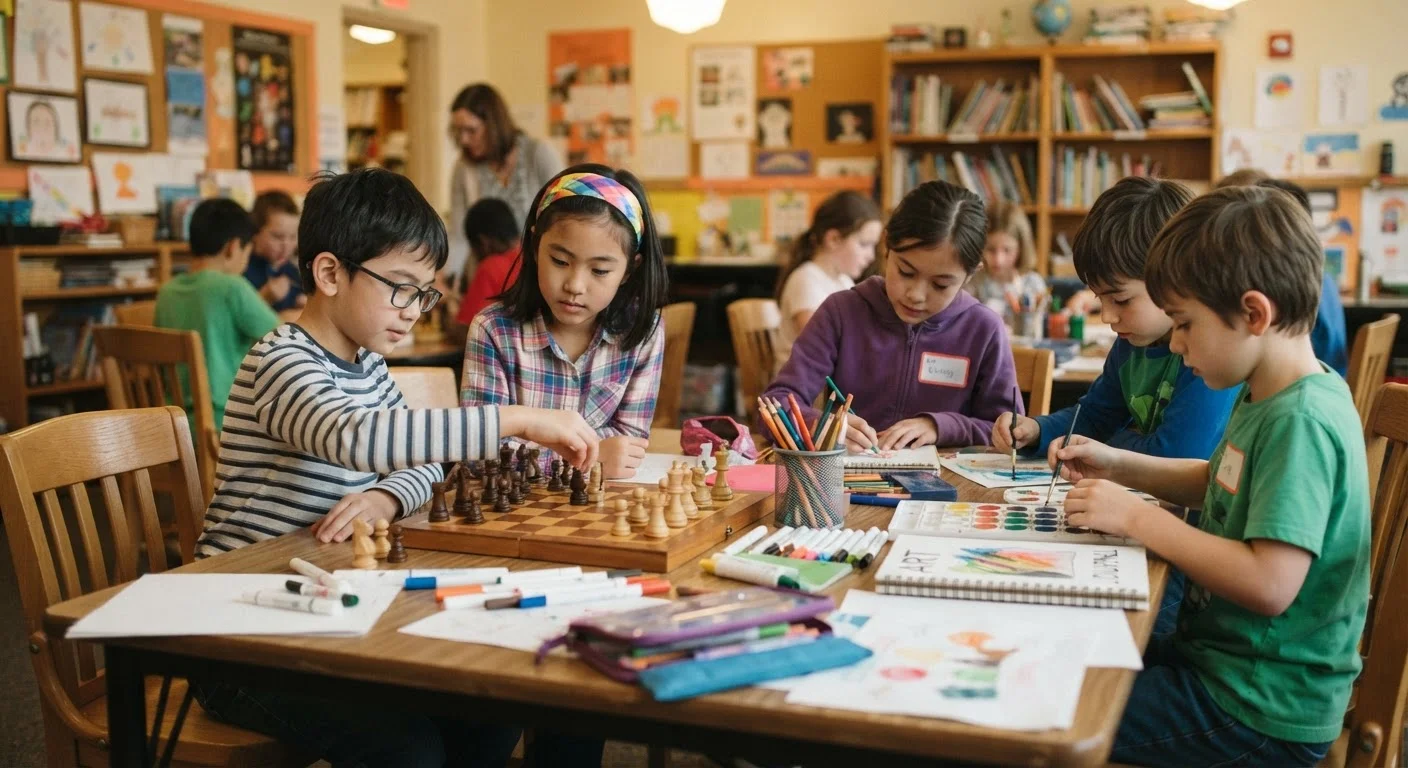
Chess is one of the most research-supported enrichment options available to school-age children. Regular play builds planning ahead, pattern recognition, and the ability to hold multiple possibilities in mind at once. These are transferable cognitive skills that show up in math and reading comprehension.
Most school-based chess clubs cost little or nothing to join, and many public libraries run free programs as well. A child does not need to be academically advanced to benefit: the game meets players at their current level and scales naturally as skill grows.
Chess builds planning and pattern recognition skills that transfer directly to math and reading.
Coding and computational thinking programs
Coding programs teach children to break problems into smaller steps, spot logical errors, and persist through debugging. Those habits apply well beyond software. Block-based programming environments designed for ages six and up let younger children build logic skills before syntax becomes a barrier.
Community centers, public libraries, and school STEM clubs frequently run free or low-cost sessions. Some programs accept sliding-scale fees. If you are wondering how these compare to app-based learning at home, see our look at free vs. paid educational apps for context on what each format actually delivers.
Debugging code teaches children to spot their own mistakes and revise their thinking systematically.
Drama and theater programs
Theater asks children to memorize text, read emotional cues in others, project confidence in front of an audience, and collaborate toward a shared deadline. Each of those skills is practiced repeatedly across a single production cycle.
Public school drama programs and community theater groups aimed at youth are often free or subsidized. The social dimension is notable: children who struggle in purely academic settings sometimes find their footing in a cast where every role has clear value.
Theater gives children repeated practice in memorization, emotional reading, and group collaboration.
Debate and public speaking clubs
Debate teaches children to construct an argument, anticipate counterarguments, and present ideas under time pressure. Written communication improves as a side effect because students must organize thoughts before they can defend them aloud.
Many middle and high schools offer debate teams at no cost. For younger children, informal speaking clubs tied to library programs or community groups provide a less competitive entry point. If your child seems academically ahead or is struggling in language arts, see signs a child is ahead or behind grade level to consider whether a challenge-focused activity fits their current needs.
Debate sharpens written and oral argument skills because students must organize ideas before defending them.
Music instruction
Learning an instrument builds sustained attention, fine motor control, and the ability to read symbolic notation, which shares structural features with mathematical notation. Children who study music for at least two years show measurable differences in phonological awareness, which underlies reading fluency.
Instrument rental and group lessons through school programs are often more affordable than private instruction. Many families find that group formats work just as well for beginners and cost a fraction of one-on-one lessons.
Two or more years of music study is linked to measurable gains in phonological awareness and reading fluency.
Science and nature clubs
Hands-on science programs, whether school-based science olympiad teams, 4-H groups, or nature clubs run through parks departments, build observation skills and comfort with hypothesis testing. Children learn to tolerate ambiguous outcomes, which classroom settings rarely require.
4-H in particular is free to join in most counties and covers a wide range of project types beyond agriculture, including robotics, food science, and environmental projects. Nature-based programs also give children time outdoors, which child development research links to reduced stress and improved concentration.
Hands-on science programs teach children to tolerate ambiguous results, a habit classroom tests rarely build.
Ask schools about fee waivers before opting out
Many after-school programs that appear to have fees offer income-based waivers that are not advertised prominently. A direct conversation with the program coordinator or school office often reveals options that the registration page does not mention. It is worth asking before assuming an activity is out of reach.
Letting your child's interest guide the decision
A child who has some genuine interest in an activity will practice between sessions, ask questions, and push through early frustration. One who was enrolled because a parent thought it would be good for them often does neither. Interest is not a soft criterion: it is one of the better predictors of whether an activity produces durable skill.
Structured enrichment is one piece of a child's learning environment. For families thinking about how much of the day to structure vs. leave open, the comparison in structured vs. child-led learning at home offers a useful frame. The goal is a schedule that builds skills without crowding out the unstructured time that also has developmental value.