

Key Takeaways
Our Verdict
Closed-cell foam is the stronger performer in tight spaces, exterior applications, and moisture-prone areas because of its higher R-value and water resistance. Open-cell foam is a practical, lower-cost choice for interior walls, attic spaces with good ventilation, and anywhere sound control matters. The decision comes down to where the foam goes and what your home specifically needs.
| Best for | Recommended |
|---|---|
| Homeowners insulating crawl spaces, basements, or exterior-facing walls | Closed-cell spray foam |
| Families prioritizing budget and interior wall or attic insulation | Open-cell spray foam |
| Those needing added structural rigidity in wall or roof assemblies | Closed-cell spray foam |
| Anyone focused on reducing noise between interior rooms | Open-cell spray foam |
What makes these two foams different
Both open-cell and closed-cell spray foam start as liquid chemicals that expand on contact. The difference is what happens inside the foam as it cures.
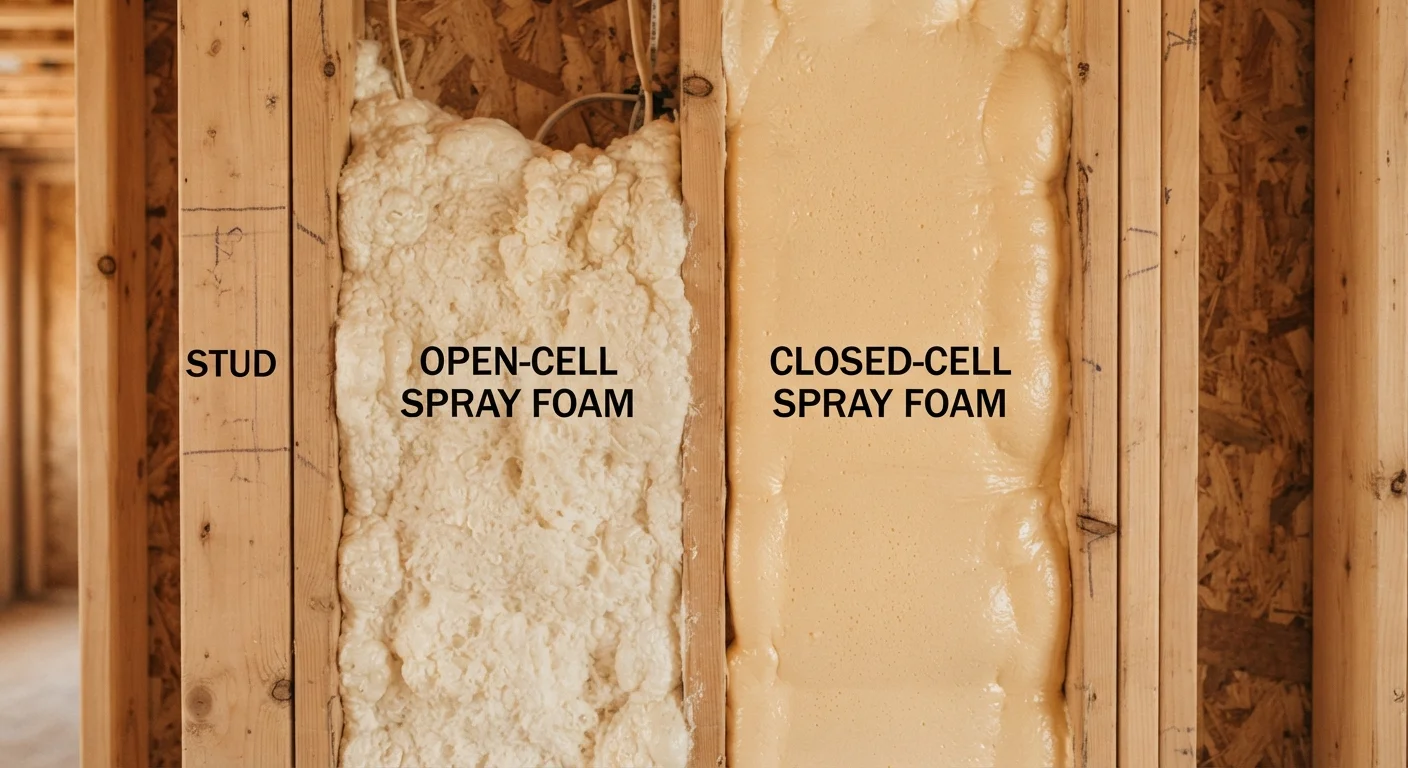
Open-cell foam has a soft, spongy texture because the tiny air pockets inside it break open during expansion. This makes the foam flexible and relatively lightweight. Closed-cell foam keeps those air pockets intact, producing a rigid, dense material that resists compression and moisture.
That structural difference drives almost every practical distinction between the two: R-value, cost, moisture behavior, and where each one belongs in a home.
R-value and thermal performance
R-value measures how well insulation resists heat flow. Higher numbers mean better thermal resistance. Closed-cell foam typically delivers around R-6 to R-7 per inch of thickness. Open-cell foam runs closer to R-3.5 to R-4 per inch.
In a thin space, like a 2x4 wall cavity, closed-cell foam can achieve a much higher total R-value than open-cell foam in the same space. If you have limited depth to work with, closed-cell is the more thermally efficient option.
For larger cavities or attic applications where depth is not a constraint, open-cell foam can still reach adequate R-values, often at a lower overall cost.
| Open-cell foam | Closed-cell foam | |
|---|---|---|
| R-value per inch | R-3.5 to R-4 | R-6 to R-7 |
| Texture | Soft, flexible | Rigid, dense |
| Vapor permeability | High (vapor-permeable) | Low (vapor barrier) |
| Relative cost | Lower cost per board foot | Two to three times higher |
| Moisture resistance | Not moisture-resistant | Resists moisture and bulk water |
| Best locations | Interior walls, attic floors | Crawl spaces, rim joists, exteriors |
| Sound dampening | Good | Moderate |
Moisture and air sealing
Both foams seal air gaps, which is one of the main reasons spray foam outperforms loose-fill or batt insulation in airtightness. The difference is how each handles moisture.
Closed-cell foam has a low permeability rating, meaning it resists water vapor passing through it. This makes it well-suited for below-grade areas like basements and crawl spaces, or anywhere the foam may be exposed to humidity or occasional moisture contact.
Open-cell foam is vapor-permeable. Moisture can move through it over time. In most above-grade interior applications this is acceptable, but it means open-cell foam should not be used in areas prone to bulk water exposure or ground contact without additional moisture management in place.
For a broader look at how air sealing fits alongside other weatherproofing methods, see caulking, weatherstripping, and draft-proofing explained.
Ask about vapor control before choosing
Before committing to open-cell foam in a climate with high humidity or cold winters, ask your contractor how vapor management will be handled. In some climate zones, open-cell foam in a roof assembly needs a vapor retarder on the warm side to prevent moisture buildup inside the structure. A qualified insulation contractor familiar with your local climate and building code can advise on the right approach for your specific situation.
Cost and installation
Open-cell foam costs less per board foot than closed-cell foam, and the gap is noticeable. Closed-cell foam typically costs two to three times more per square foot of installed coverage, partly because of the materials and partly because it requires more precise application.
Both types must be installed by trained professionals using specialized equipment. The chemicals are hazardous during spraying, and the area must be evacuated and properly ventilated. This is not a DIY job in the same category as caulking a window or laying weatherstripping.
Permits may be required depending on your local building code, particularly if spray foam is part of a larger renovation or affects your home's thermal envelope. Check with your local building department before scheduling work.
R-6 to R-7
Closed-cell foam R-value per inch
The U.S. Department of Energy notes closed-cell foam typically delivers R-6 to R-7 per inch, making it one of the highest-performing insulation materials by thickness.
40%
Heat loss through air leaks in typical homes
The U.S. EPA's ENERGY STAR program estimates that air leaks account for roughly 25 to 40 percent of heating and cooling energy loss in a typical American home.
Where each type is typically used
Closed-cell foam is common in exterior walls, roof decks, crawl spaces, rim joists, and below-grade foundations. Its density also adds some rigidity to wall assemblies, which can be useful in certain construction situations.
Open-cell foam is more common in interior walls for sound reduction, attic floors or ceilings where vapor control is handled separately, and larger interior cavities where cost is a factor.
Some contractors combine both types in a single project, using closed-cell foam in moisture-sensitive areas and open-cell foam elsewhere to manage costs without sacrificing performance where it matters most.