

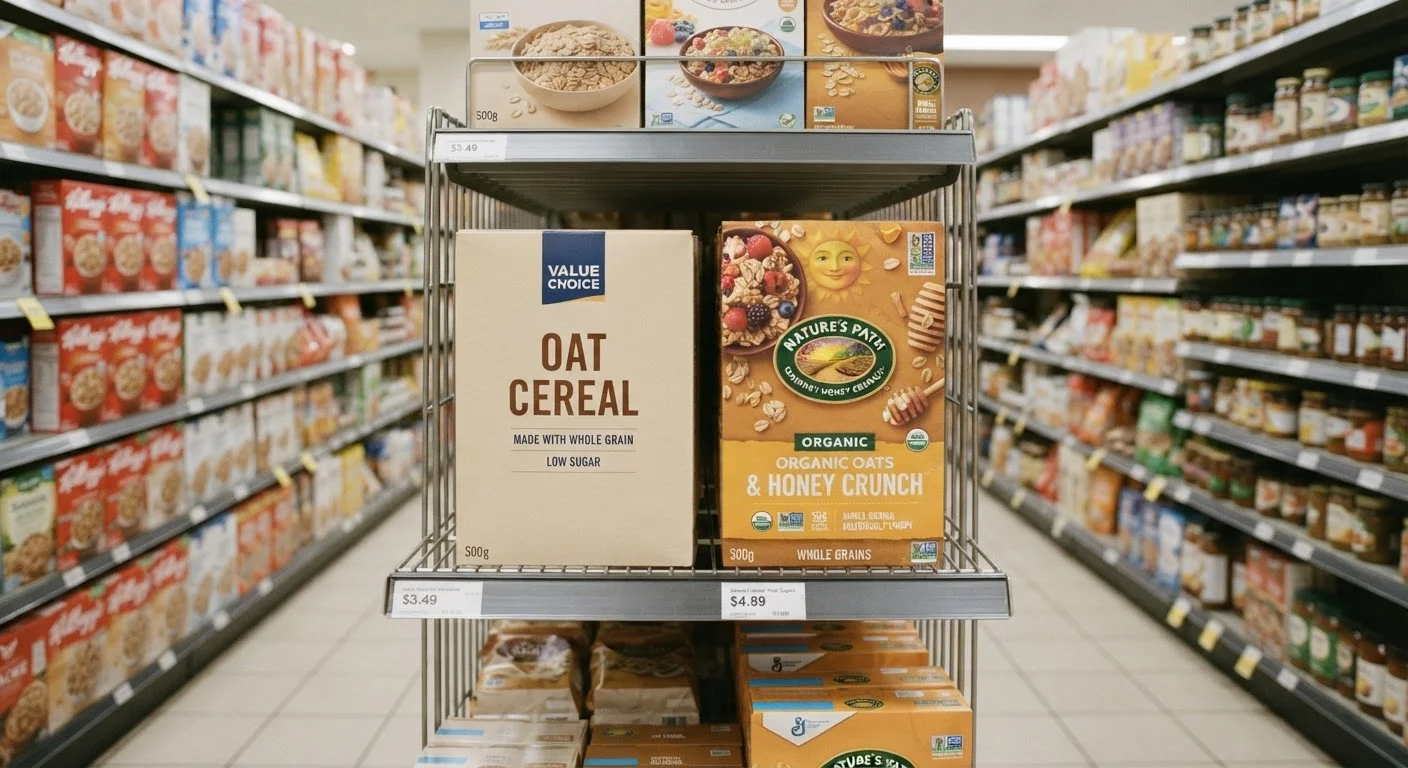
Key Takeaways
Option A
Store brand (private label)
The lower-cost, retailer-owned option.
Best for: Budget-conscious shoppers looking to reduce their grocery bill without sacrificing quality on everyday staples.
Option B
Name brand (national brand)
The established, widely marketed choice.
Best for: Shoppers who prioritize consistency, specialized formulations, or product categories where quality gaps are demonstrable.
If you buy pantry staples like flour, sugar, canned vegetables, or pasta regularly
Store brand (private label)
These products have minimal formulation differences, and the savings accumulate quickly over a monthly grocery budget.
If you need over-the-counter medications such as ibuprofen or antacids
Store brand (private label)
FDA regulations require identical active ingredients and dosage in generic medications, so you get the same therapeutic effect at a lower cost.
If you rely on a specific product with a proprietary formula or patented ingredient
Name brand (national brand)
Certain skincare, cleaning, or specialty food products use formulations that store brands do not replicate exactly, and the difference may matter depending on your needs.
If your household has strong taste preferences for a specific brand
Name brand (national brand)
Consumer satisfaction surveys consistently show that taste preference is the one area where name brands hold a durable advantage for specific products like sodas and sauces.
If you are buying cleaning supplies, paper products, or basic household goods
Store brand (private label)
Independent product testing has repeatedly found that store-brand cleaning and paper products perform comparably to name brands at substantially lower prices.
Where store brands actually come from
A widespread misconception is that store brands are manufactured in inferior facilities by unknown suppliers. In reality, many store-brand products are made by the same contract manufacturers that produce name-brand goods. A factory that fills national-brand pasta sauce jars may also fill the retailer's private-label version on the same production line. The label changes; the contents often do not.
This arrangement is common in food, personal care, and over-the-counter medications. Retailers commission products to a specification, and manufacturers take the contract because it fills production capacity. The result is that ingredient lists for store-brand and name-brand equivalents are frequently identical or nearly so.
For medications specifically, the FDA requires that generic and store-brand versions contain the same active ingredients in the same dosage as their name-brand counterparts. Bioequivalence standards mean the drug performs the same way in the body. This is one area where the quality question has a clear regulatory answer.
Understanding which quality signals actually matter can help you spot whether a product difference is real or just packaging.
What you are paying for with name brands
Name brands carry costs that have nothing to do with the product inside the package. National advertising campaigns, celebrity endorsements, shelf-placement fees paid to retailers, and elaborate packaging all get built into the retail price. Consumer research has estimated that marketing and distribution expenses can account for 20% to 40% of a name brand's cost structure, though exact figures vary by category and company.
That does not make name brands a bad deal in every case. A company that invests heavily in product development, quality control, and consistent sourcing may genuinely produce a better result in specific categories. The issue is that the price premium does not reliably tell you which scenario you are in.
| Criterion | Store brand | Name brand |
|---|---|---|
| Average price difference | 20-30% less on average | Higher retail price |
| Manufacturer origin | Often same factory as name brand | Proprietary or contracted facilities |
| OTC medication standards | FDA-required bioequivalence | FDA-regulated reference product |
| Marketing spend included in price | Minimal | Substantial |
| Specialty food categories | May lack sourcing specificity | Often stronger provenance |
| Packaging and branding | Plain, functional | Heavily designed and branded |
| Consumer taste preference (brand-specific) | Variable by product | Stronger in sodas, condiments |
Spending more upfront can sometimes be the frugal choice, but only when the quality difference is real and the product lasts longer as a result.
Categories where the gap is real
Store brands perform well across most grocery staples, but there are categories where name brands hold a genuine advantage worth paying for in some households.
- Specialty and ethnic foods: Store brands rarely replicate the sourcing relationships or regional ingredients that define certain products. Imported olive oils, artisan cheeses, and fermented condiments are examples where provenance affects flavor in a way a private-label version may not match.
- Tools and hardware: In this category, material composition and manufacturing tolerances affect how long a product holds up. Some store-brand hand tools use lower-grade steel alloys. Cost-per-use calculations often favor a more durable name-brand tool over repeated store-brand replacements.
- Skin care with active ingredients: Formulation concentration and delivery system matter in products like retinol creams or sunscreens. Store-brand versions may meet labeling requirements while using lower concentrations of active ingredients.
Common grocery budgeting beliefs often oversimplify the store-brand question by treating all categories the same way.
A practical decision framework
The most efficient approach is to default to store brands in low-risk categories and trial name brands only where you have a concrete reason to expect a difference. Low-risk categories include canned goods, dry pantry staples, cleaning products, paper goods, and generic medications. These are areas where ingredient lists are nearly identical and independent testing has found comparable performance.
Before assuming a name brand is worth the premium, check the ingredient list on both products. If the first several ingredients are identical and neither product contains a proprietary component that the other lacks, the formulation difference is likely minor. Package size and unit price math can also shift the comparison, so check the per-unit cost rather than the sticker price.
If your household has tried a store brand and genuinely prefers the name brand, that preference is a legitimate reason to pay more. Satisfaction with food and personal care products is real, and a product you will not use is not a savings.
This article is for general informational purposes only and does not constitute financial or purchasing advice tailored to your individual circumstances. Prices, formulations, and product availability vary by retailer and region.