

Key Takeaways
Unstructured play
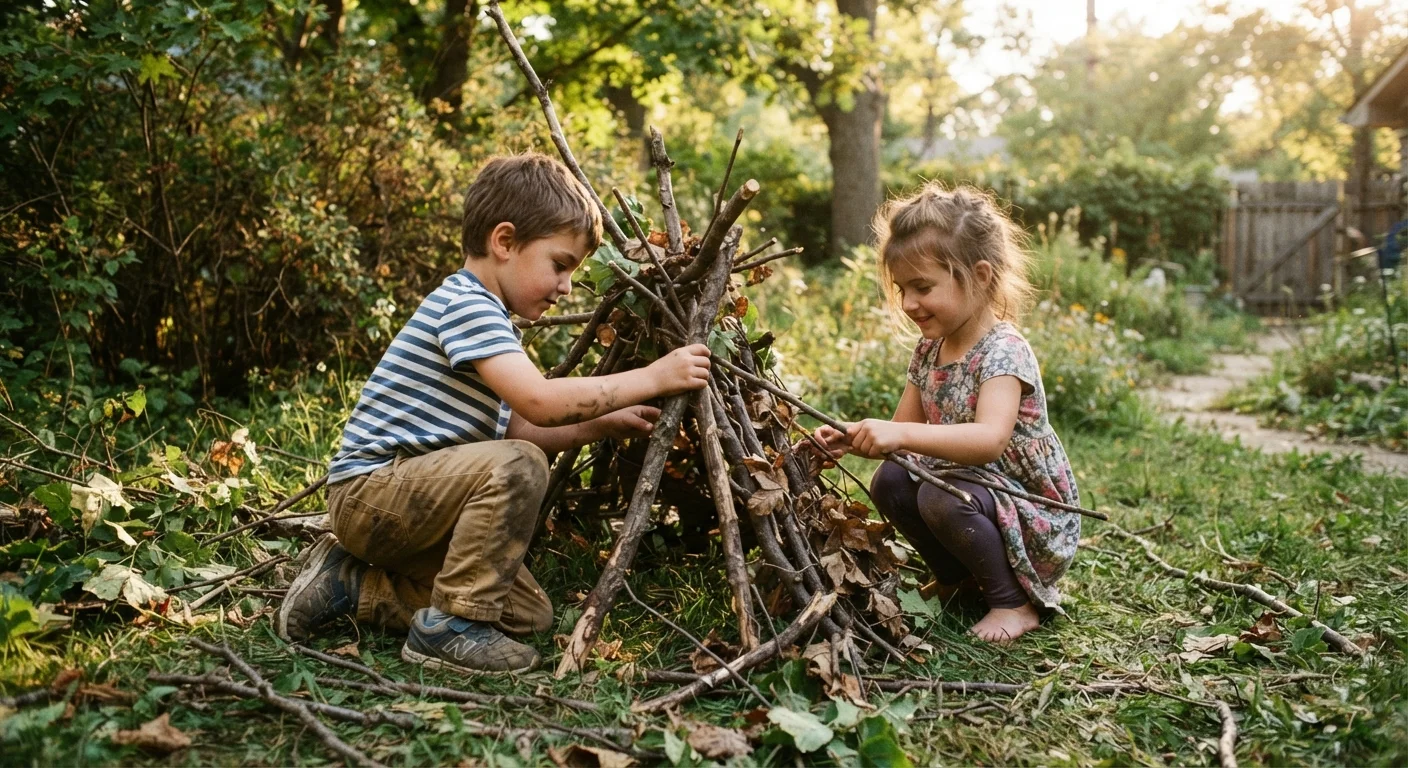
Unstructured play is child-directed free time with no predetermined outcome or adult instruction. The child chooses the activity, sets the rules, and decides when it ends. It differs from organized sports, lessons, or guided crafts because adults do not manage the goal or the process.
Developmental researchers sometimes call this 'free play' or 'self-directed play' and distinguish it from structured play (games with fixed rules) and adult-guided play (play with an educational objective set by a caregiver or teacher).
What the research actually says about play
The case for free play is not anecdotal. Decades of research in developmental psychology link child-directed play to measurable gains in executive function, which is the cluster of mental skills that includes working memory, cognitive flexibility, and inhibitory control. A widely cited body of work by developmental psychologist Adele Diamond has traced how play-based activities that require children to self-regulate, such as pretend play with role-based rules, produce stronger executive function outcomes than drill-based instruction alone.
Separate longitudinal research has found that children who have less free time and more scheduled activities show higher rates of self-reported anxiety and lower scores on measures of self-directed thinking. The mechanism researchers propose is straightforward: when adults manage every activity, children get fewer chances to practice managing themselves.
None of this argues against academic learning. The evidence consistently points to a balance. Structured and child-led learning each build different skills, and neither alone is sufficient.
A note on age and play type
The research on free play's developmental benefits applies broadly, but the form of play changes significantly with age. Toddlers benefit most from sensory and exploratory play. School-age children gain more from social and rule-based free play. Teenagers benefit from unstructured time that includes social interaction and self-chosen creative pursuits. Adjusting expectations to the child's developmental stage keeps free time genuinely useful.
What children are actually doing during free play
When a child builds a fort from couch cushions, they are making spatial judgments, negotiating with siblings, problem-solving structural failures, and sustaining attention on a self-chosen goal. None of those processes require a curriculum.
Pretend play specifically has received significant research attention. Children directing imaginary scenarios must hold multiple roles in mind simultaneously, suppress their own identity temporarily, and update the shared narrative as it changes. These are not trivial cognitive tasks. They map directly onto the kind of flexible thinking that school and adult life demand.
Social free play adds another layer. When children negotiate rules for a game they invented, they practice perspective-taking, conflict resolution, and turn management. These skills do not transfer easily from worksheets.
25%
Decline in children's free play time since the 1980s
Research compiled by psychologist Peter Gray and published in the American Journal of Play documents a substantial multi-decade drop in unsupervised child-directed play across the United States.
3-5 years
Age range when pretend play peaks
Developmental psychology literature identifies the preschool years as the period when children engage most intensively in pretend and role-based free play, coinciding with rapid executive function development.
1 hour+
Daily unstructured outdoor play recommended
The American Academy of Pediatrics has recommended at least one hour of outdoor free play per day for school-age children as part of guidelines on physical activity and healthy development.
How over-scheduling displaces play
American families have reduced children's free time substantially since the 1980s. Organized sports, tutoring sessions, and after-school programs now occupy hours that previous generations spent in unstructured neighborhood play. The intent is understandable: parents want to give children every developmental advantage.
The concern developmental researchers raise is not that enrichment activities are harmful. Enrichment activities can build genuine skills. The concern is that when structured activities fill every available hour, children lose the practice of directing themselves. That practice has its own developmental value that structured settings cannot replicate.
Budget-conscious families actually have a structural advantage here. Cutting back on paid programs to make room for free time is not a compromise. It is consistent with what child development research recommends.
Supporting free play without spending money
Free play does not require elaborate toys. The objects children most consistently use in self-directed play are open-ended: blocks, cardboard boxes, sticks, sand, water, art supplies. The common thread is that these materials have no single correct use, so the child must invent one.
The environment matters more than the materials. A learning-friendly home space that gives children some physical autonomy, access to loose materials, and time without adult interruption is the most reliable setup for productive free play.
Parents can also look at the daily schedule. If afternoons are back-to-back with structured activities, carving out 45 minutes with no agenda is a concrete, zero-cost change. Telling a child 'this time is yours, I'm not going to organize it' hands over the developmental work that free play is supposed to provide.